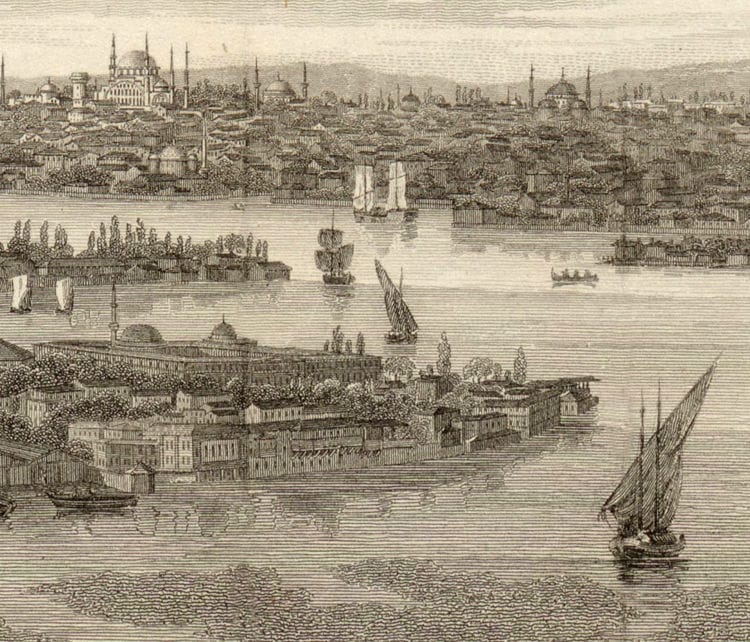
Anyone who observes the geographical location of Constantinople immediately senses its exceptional nature: it is simply the best possible place to be the center of the world. Asia and Europe, the noblest lands on the planet, find there their predestined seat of command and union. Between them lie two seas, a third element of separation, connection, and communication. Even in its physical characteristics, therefore, Byzantium embodies what may be considered the fundamental principle of its civilization: the overcoming of dualism, which brings opposites back to their essential harmony. This ideal is the interpretive key that allows us to understand the unique nature of Byzantine civilization and its irreducible otherness with respect to the West. Heaven and Earth, Church and State, reason and faith, the ancient and the modern: these are the great rifts that have shaped and sustained the identity and history of Western man—rifts that the Byzantines never experienced (and even the most significant dualism, that of body and soul, was resolved in the 14th century through Palamas’ Hesychast theology). Although aware of the antinomic aspects of reality, the Byzantine mindset believed strongly in their superior harmonization, and this makes it irrevocably “foreign” to us.
Yet this was not always the case: in the early centuries of the High Middle Ages, Europe fully embraced the Roman-Christian civilization we call Byzantine—from Ireland to Spain, from North Africa to Istria, the same attitudes and way of life found in Thessalonica or Damascus were present, expressed through local languages and traditions. The “Byzantine” West, though never part of the Roman Empire, it existed until the 8th century, in continuity with the late antique past, and came to an end with the Carolingian “Holy Roman Empire,” which fostered the development of new characteristics and brought to the fore those particular aspects of the West that had previously been secondary, marginal, or theoretical. “Our” Latin-Germanic West was born.
The Eastern Roman Empire, on the other hand, lived its political continuity and did not suffer loss of identity; indeed, the fall of the western part legitimized its claim to the inheritance of the entire Christian Roman empire. With its law, its society, its culture, its religion unchanged, it considered itself the state organism predestined by God to unify ecumenism in peace and truth. Contrary to our “modern” nature, generated by the break with the civilizations of the past and always projected towards a “reform” of himself, Byzantine man was not aware of his own autonomous identity: his history was Roman history and his literature was Greek literature, he did not consider himself “a dwarf Moderna over the shoulders of giants” like the medieval man of the West, nor did he wish to change his path saying “Who will free us of the Greeks and Romans”.
Libraries full of classic works lost to us, archives full of fundamental historical documents, cities with ancient monuments intact gave him the feeling of completeness and generated disinterest in the new and the different. This continuity devoid of the tension between past and future was universally recognized, even by enemies: we have all the Syriac, Arab and Persian sources that call the Byzantines in one way, the” Rums", the Romans; why, then, do modern Western translations of these same sources systematically replace the” Roman “of the text with a non-existent” Byzantine “or, worse, with a”Greek"? Evidently there is a rejection on the part of our culture towards this continuity between Rome and Byzantium. Is it a simple replication of the old arguments that derive from Carolingian publishing, that Byzantium is Hellenophone, Eastern, autocratic and Orthodox and therefore cannot be Roman, or is there something deeper that prevents the use of the term “Roman” towards the Byzantines? In other words, what is the breaking point that allows us to so blatantly challenge a civilization's perception of itself?
It all depends on what is meant by romanity: there is a hidden criterion for defining it and it is a religious criterion. The Roman horizon was polytheistic and constitutionally had to contain particular spaces: those possessed by the “gods of others”. There was always an altar ready for an "unknown god" in that vision characterized by openness and inclusion to infinity. A congenital pluralism without which Roman civilization was not conceivable. the right of the Gods to be worshipped as they themselves had prescribed became the right of communities and individuals to worship the deity according to their own conscience, or in the form that seemed necessary to them. From that context arose cultural pluralism, the enlargement of human relations and the recognition of individual spaces where one could follow “one's own demon”, without the binding prescriptions of a unique and all-encompassing religious vision. Here then is the fracture that the Byzantines denied, but which we feel irreconcilable: a Roman and Christian empire was an oxymoron, a contradiction in terms, when Christianity presented itself in the guise of intolerant monotheism, as happened in historical reality.
If Christianity had been content to become a privileged religion, replacing the civic gods of Rome but leaving the citizens of the empire the freedom of worship, the empire would have remained “Roman”; instead the unique and obligatory religion transformed the Roman State into a medieval State, which we cannot call differently from “Byzantine”. It was a process that took almost three centuries to establish itself definitively, from IV to VI: from the edicts of Theodosius of 391/2 prohibiting pagan cults, to that of Justinian of 529 that closed the Neoplatonic academy. This nonlinear process also manifested itself on an individual level: Cassiodorus, at the end of the fifth century, still expressed the Roman ideology in favor of religious pluralism, but Ambrose in the fourth century was already Byzantine with his desire to die a martyr, participating in the destruction of a Jewish synagogue. The fact, however, that the Byzantine civilization was not Roman confirms the principle of overcome dualism, because one does not remain anchored to one of the two old realities, the Roman and the Christian, but creates in fact a third, the Byzantine one, a synthesis between the two.
Also in other fundamental aspects of social life and culture Byzantium reflected its profound aspiration for unity: in the liturgical and artistic fields, for example, everything converged towards the idea of the encounter between Heaven and Earth, between the divine and the human. The Greek cross plan, with its equal arms, declared that the distance that God and men travel to meet was equal and that the meeting really took place, could not be a metaphor. The theology of the divine presence did not give room to the Western anguish of abandonment and suffering; from icons to sacraments to prayer, everything was considered imbued with divine grace that eliminated the distance between the creature and the transcendent. The religious essence of the Byzantine world is expressed by these words of Athanasius of Alexandria: The Logos became man, that we men might be made gods. A theology of divinization, of ontological transformation,of body and soul together, which exceeded in the synergy between Grace and human will the dualism proposed by Western Christianisms, based instead on the morality of guilt and good feelings. The Russian ambassadors, who proposed Greek Orthodoxy as a faith for their nation, were fascinated by this in Hagia Sophia: ... We did not know whether one was in heaven or on earth. For there is no such splendor or beauty on earth, and we lack the means to describe it. We only know that there God dwells among men …
But if God really dwelt among the men of Byzantium, then another remarkable consequence was produced: those men did not need much mediation between themselves and the deity. The Byzantine clergy, therefore, never had that enormous power of its Western counterpart, indeed, as the “vulgate " says, it was subjected to Caesaropapism. There was no opposition between State and Church because from the beginning the right of control and intervention in the Church was recognized to the Emperor Constantine, a layman. This situation I would not call caesaropapism, but rather “Caesarolaicism”, to get out of the strange categories to which we are addicted, for which if the Church is governed by the clergy it is “free”, if it is governed by Christian laity it is “enslaved”. The basileus, in fact, represented and concentrated in his person all the Christian people, whose sacredness was recognized and who from the beginning had exercised its power in the Church, e.g. by electing bishops. Still at the end of the empire, in times of mortal danger to Orthodoxy, the Byzantine people twice “removed the mandate” from the emperor and bishops who had signed the union with Rome in the XIIIth and in the XIVth century declared that the original source of ecclesiastical legitimacy, the” democratic " sensus ecclesiae, was opposed.
A civilization that led to the elimination of all potential conflicts was evidently an expression of the social status quo and its main commitment was to maintain that unnatural immobility. From the cultural point of view, it was therefore necessary to prevent the birth of a critical spirit that, in the dialectic between the Orthodox faith (and the institutions that were based on it) and philosophical reason, could build a cultural and social opposition. Rationality, which in the West was Aristotelian and which would have forced the Church first to prometheically demonstrate the rationality of every dogma and, subsequently, to defend its shaky building with the inquisition, in Byzantium was instead of a Neoplatonic matrix and carried in itself its own neutralization: in fact, it affirmed that there was nothing more rational than recognizing the impotence of the human mind to scrutinize the divine nature, while the mysteries and dogmas were so superior and transcendent that they rightly contradicted and caused discursive reason to implode. The upper world, which legitimized all authority, was “the darkness that shines most of all light".
Paradoxically, the whole “Irenic” and conservative ideology of Byzantium, aimed at defending reality as it is, was itself a dream, a vision of the imaginary. Reality was different and from it ideology provided the tools to escape but not to face it. Perhaps this was the weakness and at the same time the charm of the “Romean”civilization.